

Key Ideas
- AI literacy includes the knowledge and skills that enable humans to critically understand, evaluate, and use AI systems and tools to safely and ethically participate in an increasingly digital world.
- Digital Promise’s framework recommends AI literacy practices for learners and strategies for leaders to integrate into PK-12 education.
- We call on school leaders and policymakers to build on existing initiatives to champion AI literacy for all learners, educators, and community members to ensure safe and responsible use of emerging technologies.
Introduction
In our latest paper, AI Literacy: A Framework to Understand, Evaluate, and Use Emerging Technology, Digital Promise shares a framework to leverage artificial intelligence (AI) tools for powerful learning and strategies for educational leaders to implement a clear approach to AI literacy.
As AI becomes increasingly prevalent in our daily lives and educational settings, it is imperative to equip learners, educators, and leaders with the necessary skills and knowledge to navigate this technology responsibly. We envision safe, equitable, and meaningful AI and emerging technologies that improve education by enhancing how we teach and learn. Thus, AI literacy has emerged as a skill set for everyone to safely and effectively use these emerging technologies.
AI literacy includes the knowledge and skills that enable people to critically understand, evaluate, and use AI systems and tools to safely and effectively participate in an increasingly digital world.
AI Literacy Framework
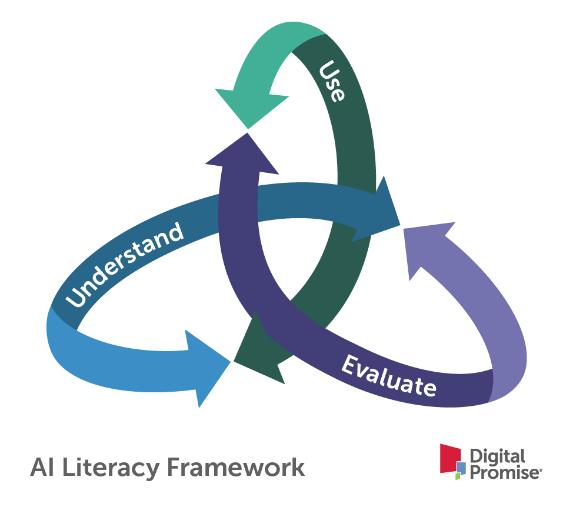
Our framework defines three interconnected Modes of Engagement to support robust engagement in AI literacy, including:
- Understand: Acquiring basic knowledge of what AI can do and how it works in order to make informed decisions about evaluating and using AI systems and tools.
- Evaluate: Centering human judgment and justice to critically consider the benefits and/or costs of AI to individuals, society, and the environment.
- Use: Interacting, creating, and problem-solving with AI as a progression of use for distinct contexts and purposes.
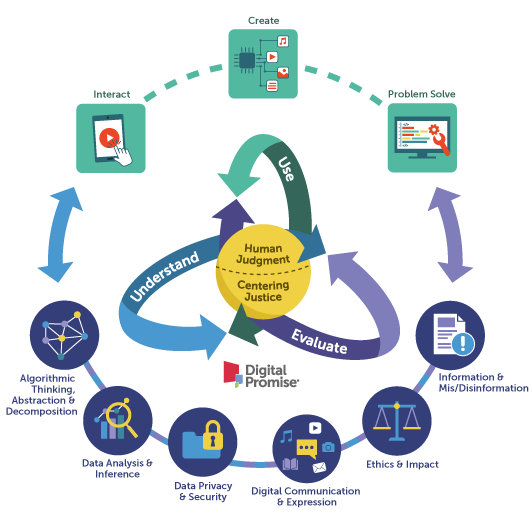
Our expanded AI Literacy Framework depicts the relationship between AI Literacy Practices, Core Values, Modes of Engagement, and Types of Use and elaborates essential components of AI literacy to support educational leaders in adapting it to their contexts.
Table 1. Components of expanded AI Literacy Framework
Strategies to Promote AI Literacy in PK-12 Education
Public schools have a critical role to integrate AI literacy throughout PK–12 education so that our current and future communities are aware and able to critically evaluate AI systems. Our paper outlines five strategies to promote AI literacy in PK–12 education, with examples and guidance for implementing each strategy.
- Strategy 1: Provide Guidance for Adoption and Evaluation
Systems Leaders and Policymakers - Strategy 2: Integrate AI Literacy Across Grades and Subject-Area Learning
System and School Administrators - Strategy 3: Facilitate Ongoing, Just-In-Time Professional Learning
Instructional Leaders - Strategy 4: Design Powerful Learning Experiences
Teachers and Instructional Leaders - Strategy 5: Promote Awareness and Agency
Leaders, Teachers, Learners, Caregivers, and Community Members
Informed users are essential for the safe and effective use of AI. We call on school leaders and policymakers to champion AI literacy for all learners, educators, and community members. Together, we can ensure the responsible adoption of emerging technologies.
Want to know more about AI literacy? Find more resources here:
- Learn more about AI literacy
- Read our AI Literacy paper and access the Executive Summary
- Interested in bringing AI literacy professional learning opportunities to your school or district? Email kflemer [at] http://digiprom.tealmedia.dev.
- View our AI Literacy Infographic
- Sign up for our Action Report newsletter to stay updated on AI Literacy.
- Topics: AI and Emerging Tech , Core Content