

Key Ideas
- A review of research on artificial intelligence (AI) in higher education found that faculty and institutional leaders are experimenting with generative artificial intelligence (GenAI), but implementation and reporting vary widely.
- ChatGPT dominates research literature, yet many studies lack specificity in describing model versions, configurations, and instructional contexts.
- Most studies focus on undergraduate learners, but there is growing research interest in applications for graduate, professional, and continuing education—particularly in fields like teacher preparation and nursing.
Over the past two years, a remarkable shift has taken place in higher education: the integration of generative AI into teaching, learning, and institutional practices. This transformation has prompted a surge in education research focused on understanding the applications and effects of generative AI in postsecondary contexts.
To better understand how the field is responding, we created AI in Higher Education, a collection of more than 300 studies that examine the uses, impacts, and designs of generative AI in higher educational settings. Published between 2022–2025, these papers include empirical research, descriptive analyses, and position pieces that explore how generative AI is being interpreted, adopted, and assessed across higher education contexts.
Tracing the Terrain
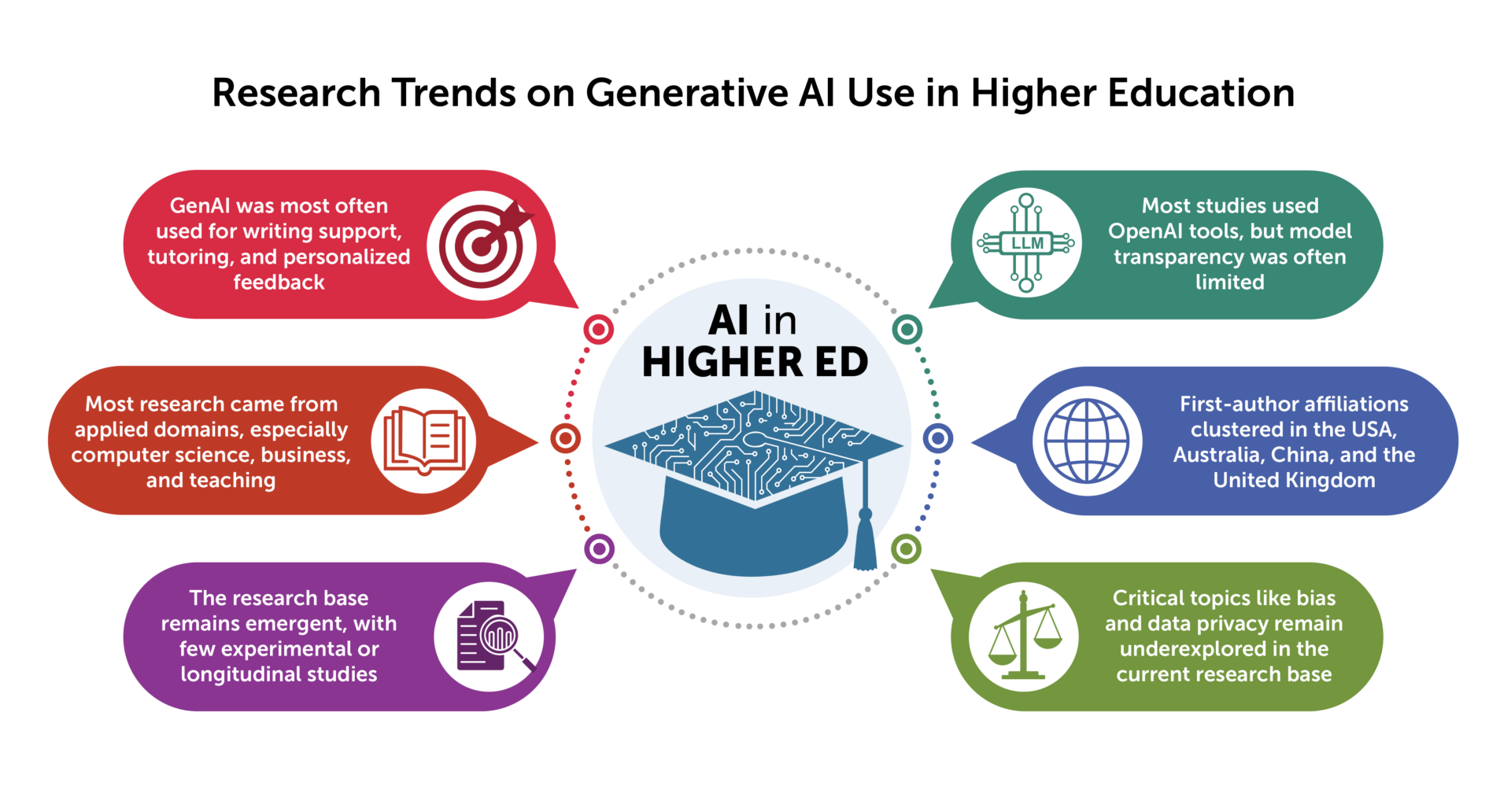
Across the dataset, the studies reflect a broad geographic distribution, with notable concentrations in the United States, Australia, the United Kingdom, and China. This spread highlights generative AI’s global uptake and research interest in higher education.
Drawing from more than 300 studies, the image below captures emerging trends in how generative AI is being studied in higher education. It showcases common applications—especially in writing and assessment—alongside disciplinary patterns, global authorship, and methodological approaches. It also points to gaps, including data privacy concerns and limited reporting on how the generative AI models were designed and configured.
Novel Applications of AI
Many studies examine AI in relation to writing and assessment. However, as the research evolves, new studies are uncovering diverse and inventive ways that generative AI is being used to support teaching, learning, and faculty development. For example:
- Curriculum vulnerability assessment: Tools like dashboards are being developed to flag parts of course curricula that are vulnerable to misuse of generative AI. These tools can then suggest proactive course redesigns to mitigate such risks.
- Simulated dialogue agents: AI agents can be used to create interactive learning environments. Examples include realistic simulations of discussions and emotionally enriched feedback designed to mitigate negative feelings towards feedback.
- Support for self-regulated learning: Generative AI is integrated into tools that scaffold metacognitive processes such as reflection, planning, and progress monitoring. Examples include dashboards that track learning performance and AI systems that prompt students to adjust learning strategies and reflect on goals.
- Faculty professional development: AI tools are being used in faculty professional development programs. Studies illustrate how generative AI can aid in lesson planning and instructional preparation, and foster more reflective pedagogical practices among postsecondary educators.
For much of this research, undergraduate settings dominate, but new work is emerging in graduate, continuing, and professional education, including teacher training and nursing education.
ChatGPT at the Center
ChatGPT was the most frequently referenced model in recent studies on generative AI in higher education. This was despite the continued diversification of the ecosystem with tools such as Google Bard, Gemini, Claude, and institution-specific tutors. While widespread use of ChatGPT reflects its ease of access and broad functionality, many studies lack detail about the specific version of the model used, or how it was configured. This absence of specificity may affect reproducibility of these studies and makes it difficult to compare findings across studies. Research on the use of generative pre-trained transformers (GPTs) in higher education remains in its early stages, with many projects still exploratory in nature and unevenly distributed across academic disciplines.
- Many studies use ChatGPT as a general-purpose tool, without modifications or specific instructional framing.
- A limited number of studies have explored specialized uses, such as prompt engineering, model comparisons, or embedding ChatGPT in multimodal environments like simulations or learning dashboards.
- Few studies have examined how ChatGPT might be adapted to meet the needs of specific student populations or institutional contexts.
- A common limitation across the literature is the lack of detail regarding how the model was implemented, including whether it was customized or used out-of-the-box. This lack of clarity further complicates the interpretation and application of research findings.
What This Means for the Field
Taken together, this collection of studies provides a panoramic view of how AI is beginning to shape educational practice—not just through technical tools, but also by raising new research questions, instructional strategies, and design opportunities.
- For researchers, this is a moment to map emerging patterns, identify design principles, and deepen methodological approaches.
- For practitioners, the variety of use cases shows that AI can be integrated into teaching and learning in creative, supportive, and responsive ways—but these implementations also require thoughtful planning and ongoing reflection.
- For the public, AI in education is more than just hype. It is a complex and evolving field, characterized by local experiments, grounded questions, and practical tools.
As AI becomes a more routine part of higher education, its long-term impact will hinge on how institutions balance technological advancement with research, inclusion, and clearly defined educational goals. The studies reviewed indicate that while the technology is advancing quickly, the practices and policies surrounding it are still taking shape. Continued experimentation is valuable, but it must be paired with rigorous evaluation and clear reporting in order to support learning across institutions.
Faculty, researchers, students, and administrators all have a role to play in shaping how AI is used, ensuring its implementation is inclusive, transparent, and responsive to local needs. In this sense, the field is not just adopting a new toolset—it is collectively designing the conditions necessary for AI to meaningfully support teaching and learning in higher education.
Related Resources for Higher Education
As campuses experiment with AI tools, the following resources can help stakeholders assess readiness, align efforts with institutional goals, and anticipate emerging needs.
- In January 2025, the U.S. Department of Education released the report Navigating Artificial Intelligence in Postsecondary Education to guide postsecondary education leaders on implementing AI technologies in institutional operations and academic settings.
- EDUCAUSE’s Higher Education Generative AI Readiness Assessment is designed to provide higher education leaders with a sense of their institution’s preparedness for strategic AI initiatives.
- Ellucian’s 2024 AI in Higher Education Report delivers key insights from hundreds of higher education administrators, highlighting the impact of AI on institutional operations and student success.
- The National Institute of Standards and Technology extended the AI Risk Management Framework (AI RMF) to include Generative Artificial Intelligence Profile to address risks specific to generative AI technologies.
- Topics: AI and Emerging Tech , Classroom Practice
- Audiences: Researchers
- Programs: Learning Sciences Research