

Instructional Coaching for Tech-Enhanced Approaches to Mathematics
Part of Learning Sciences Research
Instructional Coaching for Tech-Enhanced Approaches to Mathematics (iCoachTEAM) is a program designed to help instructional coaches support middle school mathematics teachers in using technology to promote conceptual understanding and conduct formative assessment.
Audiences
Learning Environments
Overview
Using the iCoachTEAM resources, coaches work with mathematics teachers to create math-specific instructional goals and use high-quality mathematics instructional strategies to make improvements to their mathematics teaching. The resources are designed to center coaching attention on mathematics instruction, specifically on promoting conceptual understanding and conducting formative assessment with technology—especially with focus students (those who are testing one year or more behind in grade-level math). The resources can enhance the work of any coach, whether they use an established coaching model or take a more flexible approach.
The iCoachTEAM resources are usable by teachers and administrators as well. We encourage anybody with an interest in implementing high-quality mathematics instruction to explore and use these materials.
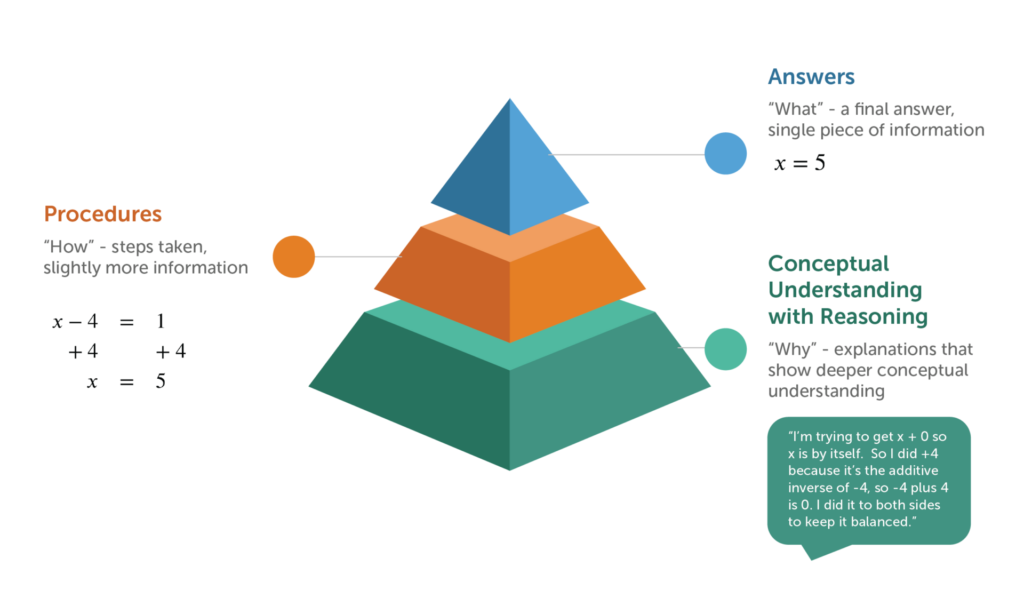
Simon, M. (2025). What is a mathematical concept? Mathematics Teacher – Learning and Teaching PK-12, 118(4). https://doi.org/10.5951/MTLT.2024.0228
National Council of Teachers of Mathematics (2014). Principles to Actions: Ensuring Mathematical Success for All. NCTM.
iCoachTEAM Resources
iCoachTEAM offers a collection of math-specific coaching resources created to support teachers in implementing high-quality math instruction with technology to promote conceptual understanding and conduct formative assessment. The iCoachTEAM resources are designed to be used on their own or in combination with a subject-agnostic coaching model when focusing on math instruction. Resources are organized according to common activities that happen throughout a coaching process regardless of the model being followed, from getting started and setting goals to implementing new strategies and reflecting.



Professional Learning Opportunities
We offer customizable professional learning opportunities to help coaches, teachers, and administrators promote conceptual understanding and conduct formative assessment to enhance student learning in math.
Our professional learning services build on our collection of research-based iCoachTEAM resources to promote high-quality mathematics instruction. We partner with you to provide a professional learning experience that meets your needs, whether you’re looking to dive into a specific instructional strategy or seeking comprehensive, sustained support for coaching to enhance high-quality math instruction.
We work with you to customize any of the below options to address your goals, current challenges, scheduling needs, and budget.
What Professional Learning Opportunities Does iCoachTEAM Offer?
| Customizable Offerings | Description | Time Commitment |
|---|---|---|
| Math Strategy Workshops | Dive into research-based instructional strategies for mathematics to learn about the strategy, its benefits for student math learning, and how to implement it in the classroom. | Half day-1 day per chosen strategy |
| Math Coaching Institutes | Go deeper into our math-focused coaching resources, from goal-setting to data collection, and create a clear plan for implementing math coaching in your school or district. | 2-3 days |
| Comprehensive Partnerships | Our most comprehensive service, including year-long ongoing support. We work closely with district and school leaders, coaches, and teachers to design a professional learning program for your needs, so you can implement and sustain instructional improvement in mathematics. | 3- to 4-day institute, then monthly support throughout the year |
Why Choose iCoachTEAM Professional Learning?
Research-Based
Our services, like our resources, are informed by extensive research in mathematics education, so you know you’re learning evidence-based approaches to mathematics instruction.
Expert Facilitators
Learn from experienced professional development facilitators, including the Digital Promise mathematics education research team and instructional coaching experts who understand the realities of today’s classrooms and schools.
Flexible and Customized
We work with you to tailor content and delivery to meet your unique goals, current challenges, scheduling needs, and budget.
Focus on Sustainability
Our goal is to build internal capacity within your staff, equipping your teachers, coaches, and leaders with the tools they need for long-term success.

Who Is iCoachTEAM Professional Learning For?
- Educators interested in promoting conceptual understanding and conducting formative assessments to enhance student learning in mathematics
- Instructional coaches and teacher leaders looking for math-specific guidance for coaching mathematics teachers
- Mathematics teachers seeking support in implementing a specific iCoachTEAM strategy
- School and district leaders interested in professional learning for their coaches and mathematics teachers
Professional Learning Opportunities
Contact us to schedule a consultation to discuss your professional learning needs and explore which service is right for your school or district.
About
The iCoachTEAM’s vision is for each and every student to have access to high-quality mathematics instruction. To achieve this vision, we designed, implemented, and evaluated instructional coaching resources that help coaches partner with middle school math teachers to better use available technology tools in meaningful ways so students develop a deeper conceptual understanding of math, especially focus students (i.e., students whose test scores are a year or more behind grade level).
The iCoachTEAM project began as a five-year grant, spanning from January 2021 to December 2025, funded by the Department of Education’s Education Innovation and Research (EIR) grant. The grant supported the design of a coach training program through the following activities:
2021–2022
Co-design the iCoachTEAM coaching program with partner districts and coaches.
2021–2025
Conduct iterative cycles of continuous improvement data collection, analysis, and program refinement of the designed coaching program.
2022–2024
Pilot full coaching program with the first cohort of coaches who participated for two school years.
2023–2025
Fully implement the coaching program with the second cohort of coaches, who participated for two school years. Evaluate the coaching program and share research findings.
Meet the Team
 Nicola Hodkowski, Ph.D., is the director of mathematics education research at Digital Promise. She leads iCoachTEAM and its initiatives for professional learning, development of research-based resources, and continuous improvement research. Nicola began her career in education more than 20 years ago as a classroom teacher. After 10 years in the classroom, she earned her Ph.D. and moved out of the classroom to partner with teachers in researching students’ ways of reasoning about mathematics. Her current research investigates teachers’ shift toward more conceptual ways of teaching mathematics, understanding how one learns mathematics, and identifying what students know as a way to advance what they do not yet know. Nicola received her doctorate in mathematics education from the University of Colorado Denver.
Lauren McMahon, Ph.D., is a mathematics education researcher at Digital Promise who supports professional learning, development of research-based resources, and continuous improvement research for iCoachTEAM. She has more than a decade of experience working with third- through 12th-grade students in mathematics and enjoys supporting practitioners as they create positive and meaningful mathematics learning experiences for all students. Lauren’s research focuses on mathematics teaching and learning, classroom discourse, and professional development for high-quality mathematics instruction. She holds a Ph.D. in educational studies, specializing in mathematics education, from the University of Michigan, an M.S. in mathematics from Texas State University, and a B.A. in mathematics and business administration from Trinity University.
Heather Dowd, M.S.Ed., is an educator, author, and instructional coaching expert. As a program designer and coach mentor for iCoachTEAM, she developed professional learning experiences for participants and supported coaches in strengthening their coaching practice. Heather draws from her experience as a classroom teacher and instructional coach in her current work writing instructional materials for educators designed to support effective teaching and learning. She is committed to helping teachers create meaningful, student-centered learning experiences that inspire curiosity and deepen understanding. Heather received a B.S. in physics from Illinois State University, an M.Ed. from the University of Illinois, and an M.S. in education from Northern Illinois University.
Angela Hardy, M.A., is a senior education researcher at Digital Promise who supports continuous improvement research for iCoachTEAM. Before joining Digital Promise, Angela spent nearly a decade as a high school and middle school teacher, teaching humanities courses in north Texas and the south of France. She’s still a teacher at heart and is passionate about collaborating with educators and students in co-design and co-research. Angela’s research focuses on instructional coaching for technology integration and mathematics, teacher and leader development, and curriculum and instruction in history. She received her M.A. in international education policy analysis from Stanford University and her B.A. in history and French from the University of North Texas.
Latia White, Ed.D., is the director of collaborative innovation research at Digital Promise. In her role with iCoachTEAM, she contributed to the development of the project’s instructional coaching resources and tools and supported efforts to ensure they can be sustained and scaled in practice. Latia brings extensive experience in learner-centered design and in helping educators create instruction that draws on the strengths, perspectives, and academic knowledge students bring to the classroom. Her work focuses on designing practitioner learning experiences, developing practical research-based materials, and supporting educators as they build environments where all students can engage meaningfully in learning. Latia holds an Ed.D. in organizational leadership. Her doctoral research examined learning differences, teacher efficacy, and collective efficacy.
Mai Chou Vang, M.A., is a senior researcher at Digital Promise who supports continuous improvement research for the iCoachTEAM Program and directs the evaluation of the Illinois Virtual Instructional Coach and Building Mentor Program. Before joining Digital Promise in 2018, Mai Chou spent several years in education research and evaluation roles at WestEd and MyPath, focusing on youth programs and standards implementation. Mai Chou’s research focuses on mixed-methods evaluation, teacher professional development, coaching for technology integration, education policy, and literacy/writing instruction tools. She received her M.A. in education policy from Teachers College, Columbia University, and her B.A. in architecture with a minor in education from the University of California, Berkeley.
Viki Young, Ph.D., is chief researcher, pathway innovations and co-leads the Center for Learner Pathway Innovations. Across national, state, and local contexts, Viki leads research studies featuring mixed qualitative and quantitative methods, with a particular focus on teaching and learning within embedded contexts and the system supports, resources, incentives, and disincentives that shape change and unintended consequences. She has studied the implementation and impact of K-12 policy and improvement initiatives, including high school reform, inclusive STEM high school models, instructional coaching and educator development, and school choice initiatives. Before joining Digital Promise in 2019, she was director of the Center for Education Policy at SRI International. She holds a Ph.D. in education administration and policy analysis at Stanford University.
Research About iCoachTEAM
Classroom Observation Tools
The classroom observation tools are designed to observe how technology is integrated into math instruction for conducting formative assessment and promoting conceptual understanding. These tools can be used to understand a math teacher’s starting point, to observe changes in how the teacher implements technology over time, and to draw comparisons across different classrooms.
- Formative Assessment Observation Tool: We define formative assessment as the ability to elicit and respond to students’ mathematical thinking. This tool can be used to observe teachers’ use of technology to elicit and respond to students’ mathematical reasoning.
- Conceptual Understanding Observation Tool: We draw from Simon’s (2017) definition of a concept to define conceptual understanding as knowledge of the mathematical necessity of a particular mathematical relationship. This tool can be used to observe the depth of the cognitive demand teachers facilitate when using technology, and students’ productive struggle with technology and mathematics.
References
Simon, M. A. (2017). Explicating mathematical concept and mathematical conception as theoretical constructs for mathematics education research. Educational Studies in Mathematics, 94, 117–137.


Have questions or want to learn more?

This license enables reusers to distribute, remix, adapt, and build upon the material in any medium or format for noncommercial purposes only, and only so long as attribution is given to the creator. If you remix, adapt, or build upon the material, you must license the modified material under identical terms.
CC BY-NC-SA includes the following elements:
BY: Credit must be given to the creator.
NC: Only noncommercial uses of the work are permitted.
SA: Adaptations must be shared under the same terms.