
Activities
Explore Preschool CT Activities
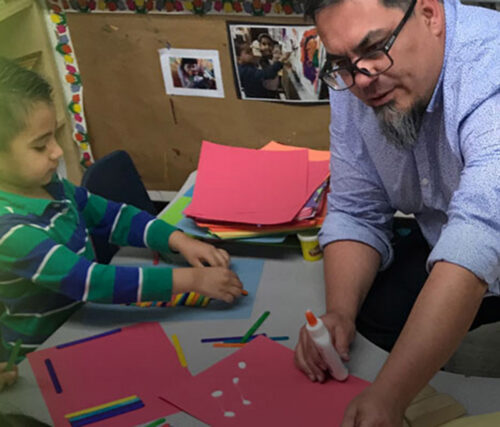
View activities that educators and families can implement during circle and story time, small group play, throughout the day, and at home.
Part of Learning Sciences Research
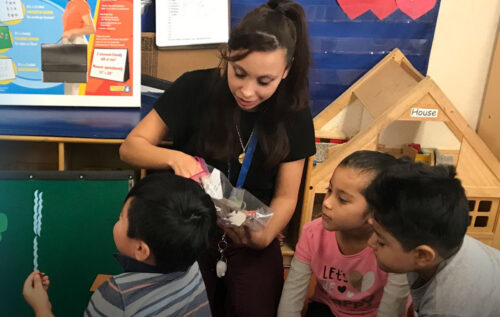
While computational thinking (CT) has received increasing attention over the past decade, CT in early learning settings is an emerging area of focus.
Our project, funded by the National Science Foundation (NSF), is a collaboration with SRI International, Edfinity, and Curious Media aimed at identifying CT skills that align with the abilities and interests of preschool children (ages 3-5), while also examining how CT can be integrated meaningfully to promote adaptive learning strategies effective for early learning. Read more about the project findings on our blog.
In this exploratory project, we focus on this subset of CT skills:
Activities
View activities that educators and families can implement during circle and story time, small group play, throughout the day, and at home.
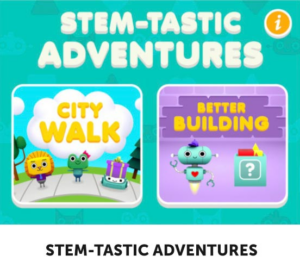
The STEM-tastic Adventures app is intended to help young children practice and learn CT skills in the context of the STEM connections we identified. The app, along with the related hands-on activities, was co-designed with preschool educators and families, media and curriculum developers, and researchers, and found to help children learn important computational thinking and STEM concepts. You can download STEM-tastic Adventures for free on the App Store and Google Play platform.
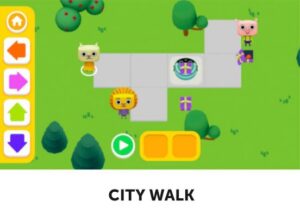
City Walk invites children to create a sequence of navigation instructions (algorithms) for their robot friend to deliver gifts around town. The app scaffolds this process by progressively introducing more complex tasks and helping children learn how to identify errors (debugging) via visuals and audio feedback. City Walk promotes visual spatial thinking and introduces visual spatial vocabulary, such as forward, backward, left, and right, in an engaging way.
Better Building invites children to closely observe and sort objects by color, shape, and size (math and science), and label groups to help the robot friend more efficiently build structures. Children practice hiding unnecessary details and highlighting important information (abstraction).

A main goal was to investigate how computational thinking (CT) skills could be meaningfully and equitably promoted across preschool and home. Our approach gathered teachers, families, researchers, and media designers to share their unique perspectives and insights, brainstorm whether and which CT skills could be consequential for early learning, and collaboratively develop (and test) hands-on activities and digital apps. Read more about our approach in our blog post.
Our work also involved investigating connections between CT and early math and science. As teachers, families, researchers, and media designers co-designed activities, they explored which connections emerged organically.
| CT and Early Math | CT and Early Science |
|---|---|
| Most of the CT activities that emerged during co-design meetings provided children opportunities to practice and strengthen their understanding of math concepts. | Only a few of the CT activities that emerged during co-design involved science; activities that did supported children’s engagement in science practices. |
| Examples:
Learning experiences designed to promote algorithms often involved visual-spatial activities, as well as numeral recognition and counting. For example, children learned to give/read a sequence of directions for peers to navigate spaces. When working with loops, they learned to create codes using numbers. When children decomposed problems and engaged in abstraction activities involving sorting, they often practiced counting and comparing quantities. For instance, children counted the number of subtasks they needed to complete when they decomposed problems and compared quantities in groups they had sorted. |
Examples:
Learning experiences designed to promote abstraction (CT) often involved sorting objects based on observable characteristics as a way of highlighting necessary information (while ignoring irrelevant or unnecessary information). For example, children discussed how sorting food at the market can help customers easily find what they need or how sorting toys or blocks could help them build towers or ramps and pathways more efficiently. |
The Digital Promise Early Learning team led this study in collaboration with SRI Education, Edfinity, and Curious Media. Special thanks to our preschool partners at Napa County Office of Education, Sunnyvale School District, and Northern Virginia Family Services Head Start. We are very grateful for the teachers, families, and children at each of those organizations who were involved in the co-design and pilot study efforts. We want to also extend a thank you to the external evaluator on the project, David Reider.
Dominguez, X., Kamdar, D., Leones, T., Grover, S., & Vahey, P. (2025). Preschool Problem Solvers: Developing Assessment Tasks to Measure Young Children’s Learning of Computational Thinking Skills and Practices. Education Sciences, 15(10), 1360. https://doi.org/10.3390/educsci15101360
Grover, S., Dominguez, X., Leones, T., Kamdar, D., Vahey, P., & Gracely, S. (2022). Strengthening Early STEM Learning by Integrating CT into Science and Math Activities at Home. In Computational Thinking in PreK-5: Empirical Evidence for Integration and Future Directions (pp. 72-84). https://dl.acm.org/doi/pdf/10.1145/3507951.3519290
Kamdar, D., Grover, S., Vahey, P., Leones, T., & Dominguez, X. (2021). Computational thinking in preschool: Bridging home and School. In Proceedings of the 15th International Conference of the Learning Sciences-ICLS 2021. International Society of the Learning Sciences. https://repository.isls.org/handle/1/7429
Grover, S., Biswas, G., Dickes, A., Farris, A., Sengupta, P., Covitt, B., Gunckel, K., Berkowitz, A., Moore, J., Irgens, G. A., Horn, M., Wilensky, U., Metcalf, S., Jeon, S., Dede, C., Puttick, G., Bernstein, D., Wendell, K., Danahy, E., Cassidy, M., Shaw, F., Damelin, D., Roderick, S., Stephens, A. L., Shin, N., Lee, I., Anderson, E., Dominguez, X., Vahey, P., Yadav, A., Rich, K., Schwarz, C., Larimore, R., & Blikstein, P. (2020). Integrating STEM and Computing in PK-12: Operationalizing Computational Thinking for STEM Learning and Assessment. In Gresalfi, M. and Horn, I. S. (Eds.), The Interdisciplinarity of the Learning Sciences, 14th International Conference of the Learning Sciences (ICLS) 2020, Volume 3 (pp. 1479-1486). Nashville, Tennessee: International Society of the Learning Sciences. https://repository.isls.org/handle/1/6353
Dominguez, X., Balisciano, P., Gracely, S., Grover, S., Kamdar, D., Leones, T., & Vahey, P. (2020, May 5). Developing the next generation of problem solvers: Investigating the integration of computational thinking into preschool mathematics and science [Video]. 2020 STEM for All Video Showcase. https://stemforall2020.videohall.com/presentations/1884.html
Kamdar, D., Dominguez, X., Grover, S., Vahey, P., Rafanan, K., Gracely, S., & Leones, T. (2020). Researchers, Teachers and Families Co-Design Resources Linking Computational Thinking with Math and Science in Preschool. In Proceedings of the Annual Meeting of the American Education Research Association (AERA), San Francisco, CA (virtual). https://doi.org/10.3102/1582113
Grover, S., Fisler, K., Lee, I., & Yadav, A. (2020, February). Integrating Computing and Computational Thinking into K-12 STEM Learning. In Proceedings of the 51st ACM Technical Symposium on Computer Science Education (pp. 481-482). https://doi.org/10.1145/3328778.3366970
Grover, S., Dominguez, X., Kamdar, D., Vahey, P., Moorthy, S., Rafanan, K., & Gracely, S. (2019, February). Integrating Computational Thinking in Informal and Formal Science and Math Activities for Preschool Learners. In Proceedings of the 50th ACM Technical Symposium on Computer Science Education (pp. 1257-1258). https://doi.org/10.1145/3287324.3293837




 This material is based upon work supported by the National Science Foundation under Grant 1827293. Any opinions, findings, and conclusions or recommendations expressed in this material are those of the author(s) and do not necessarily reflect the views of the National Science Foundation.