Curriculum
Art: Playdough Workshop: Preschool CT Activity
Part of Exploring Computational Thinking in Preschool Resources

Audiences
Related Programs
Topics
Learning Environments
Summary
Children will make playdough creations and engage in problem decomposition as they make creations. Children will identify all the smaller tasks they can tackle to make their big creation. Children will share their thoughts about breaking down the parts to make the big task easier. As children engage in this activity, they will have opportunities to identify and replicate shapes, count objects, compare lengths, and explore cardinality.
CONTEXT: Small group
LENGTH: 15 minutes
MATERIALS:
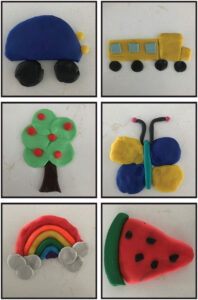
- Playdough creation ideas (see printout with examples)
- Playdough (assorted colors)
In this activity, children will engage in:
Computational Thinking
- Break a complicated, bigger problem into a set of easier, more solvable sub-problems, before working to solve them.
Mathematics
- Identify shapes and properties.
- Replicate shapes.
- Count objects (one-to-one correspondence).
- The last number counted represents how many (cardinality).
- Compare lengths (non-standard).
Activity Steps
1. Explain and define problem decomposition.
- Problem decomposition is breaking a big problem or task down into smaller parts. This can make those bigger, more complex problems or tasks easier to solve or help us solve them faster.
2. Provide a set of playdough creation images/cards. (Note: Example images are provided below. You may use these to create images/cards for children or make up your own ideas.) Explain that each child is going to make a playdough creation and will focus on how to break down the big task into smaller parts so they can more easily build their own version. Invite each child to pick an image/card that will show them what to make.
- Look closely at the picture that you chose. What details do you notice? How can you break this into smaller parts so that it’s easier to make? What will you do first?
3. Promote math talk as children work; invite children to notice and identify shapes and to count.
- What shape are the leaves?
- How many leaves do you need? Let’s count them. How many do you need all together?
4. Once the children have completed their playdough creations, encourage them to share their process.
- What was your big playdough creation? How did you break it into smaller parts? Did this help you make the playdough creation? How did it help?